Sam Altman, chief executive officer of OpenAI, during a media tour of the Stargate AI data center. | Bloomberg via Getty Images
Another researcher is challenging OpenAI about the data driving its increasingly impressive array of mathematical discoveries. Just days after a bitter row erupted over whether the company's models benefited from unpublished work, a second mathematician has come forward accusing the AI giant of unethical and "dishonest" behavior and a lack of transparency about the origins of its training data.
In a seriesofposts on Mastodon, mathematician Andreas Thom raised concerns that interactions he and his colleagues had had with the ChatGPT chatbot before OpenAI's triumphant announcement may have contributed to its success in the field. One of the …
Wer die AfD besiegen will, muss eine wirkliche Alternative zum Kapitalismus anbieten. Ein anderes Wirtschaftssystem ist nicht nur möglich – sondern nötig. mehr...
"Eine echte Alternative für Deutschland bietet nur der Demokratische Sozialismus. Er stellt die Mehrheit der Bevölkerung – die arbeitende Klasse – in den Mittelpunkt seiner Politik. Er ermöglicht es den Arbeitenden, selbst über die Belange ihrer Betriebe zu bestimmen. Er erkennt, dass die sozialen und ökologischen Krisen des Kapitalismus dem System innewohnen und sich nur mit einer vernünftigen Politik jenseits der Profitlogik lösen lassen."
Künstliche Intelligenz hat längst ihren Weg in die Arbeitswelt gefunden. In den Führungsetagen deutscher Unternehmen herrscht Handlungsdruck: Wer nicht investiert, gilt schnell als abgehängt. Informatiker und Philosoph Jürgen Geuter, der unter anderem Parteien und den Bundestag zum Thema berät, sieht diese Entwicklung kritisch. Er hat sich bereits bei Tech-Hypes wie Blockchain/Web3 oder dem Metaverse einen Namen als Tech-Kritiker gemacht.
Geuter sieht ein ökonomisches Missverständnis darin, dass die Implementierung von KI immer Produktivitäts- und Effizienzgewinne mit sich bringen würde. Im Gespräch erklärt er, wieso viele Unternehmen zu »Nachahmern« werden, wie Tech-Unternehmen zur Verantwortung gezogen werden können, und wie Demokratien den Umgang mit der neuen Technologie noch gestalten können.
Elena Winter: Herr Geuter, würden Sie sich als optimistischen Menschen bezeichnen?
Jürgen Geuter: Wir telefonieren gerade miteinander, daher können Sie es nicht sehen: Ich trage als Tattoo auf meinem rechten Unterarm ein Zitat des italienischen Philosophen und Kommunisten Antonio Gramsci: »Pessimism of the intellect, optimism of the will«. Das fasst meine Haltung ganz gut zusammen. Ich denke, es gibt Dinge, die man sich kritisch ansehen und bei denen man verstehen sollte, warum sie nicht funktionieren. Die optimistische Sicht liegt für mich darin, fest daran zu glauben, dass wir vieles an diesen Dingen besser machen können. Wir wissen beispielsweise, was wir gegen die Klimakrise tun könnten oder wie sich die Sozialsysteme oder die Gesundheitsversorgung besser organisieren ließen. Leider mögen viele die Antworten auf bestimmte Fragen nicht – das heißt aber nicht, dass es sie nicht gibt und dass wir uns nicht dafür einsetzen sollten. Dieser gemeinsame Einsatz für bessere Lösungen ist das, was für mich Demokratie ausmacht.
Dann lassen Sie uns doch über Fragen und Antworten in der großen KI-Debatte sprechen: In fast allen Wirtschaftsbereichen wird intensiv über den Einsatz von generativer KI diskutiert, also von KI, die nicht nur Daten analysiert, sondern auch neue Inhalte wie Texte, Bilder, Musik oder Videos erstellt. Wie erklären Sie sich den Handlungsdruck, der in deutschen Unternehmen derzeit herrscht?
I’m quickly learning that this is probably the most pervasive sort of work-side AI slop we’re all seeing, even outside of the Tech Industry bubble. People creating vast crap documents that we’re all forced to read or get AI to read for us and then respond with even MORE AI doc slop. It’s all awful, all the way down.
Fridays are when I get a bit more personal: chatting about what I'm working on, sharing sketches of WIP strips, dredging up old stuff from my cartooning past and recommending some music i’ve been listening to lately. You can also claim your own DT! avatar. Come and join us beyond the paywall…
Got a bunch of sketches done recently for new strips. This one I tried to note down as fast as I could, but I can already feel it starting to subtly change in my head the more I think about it…
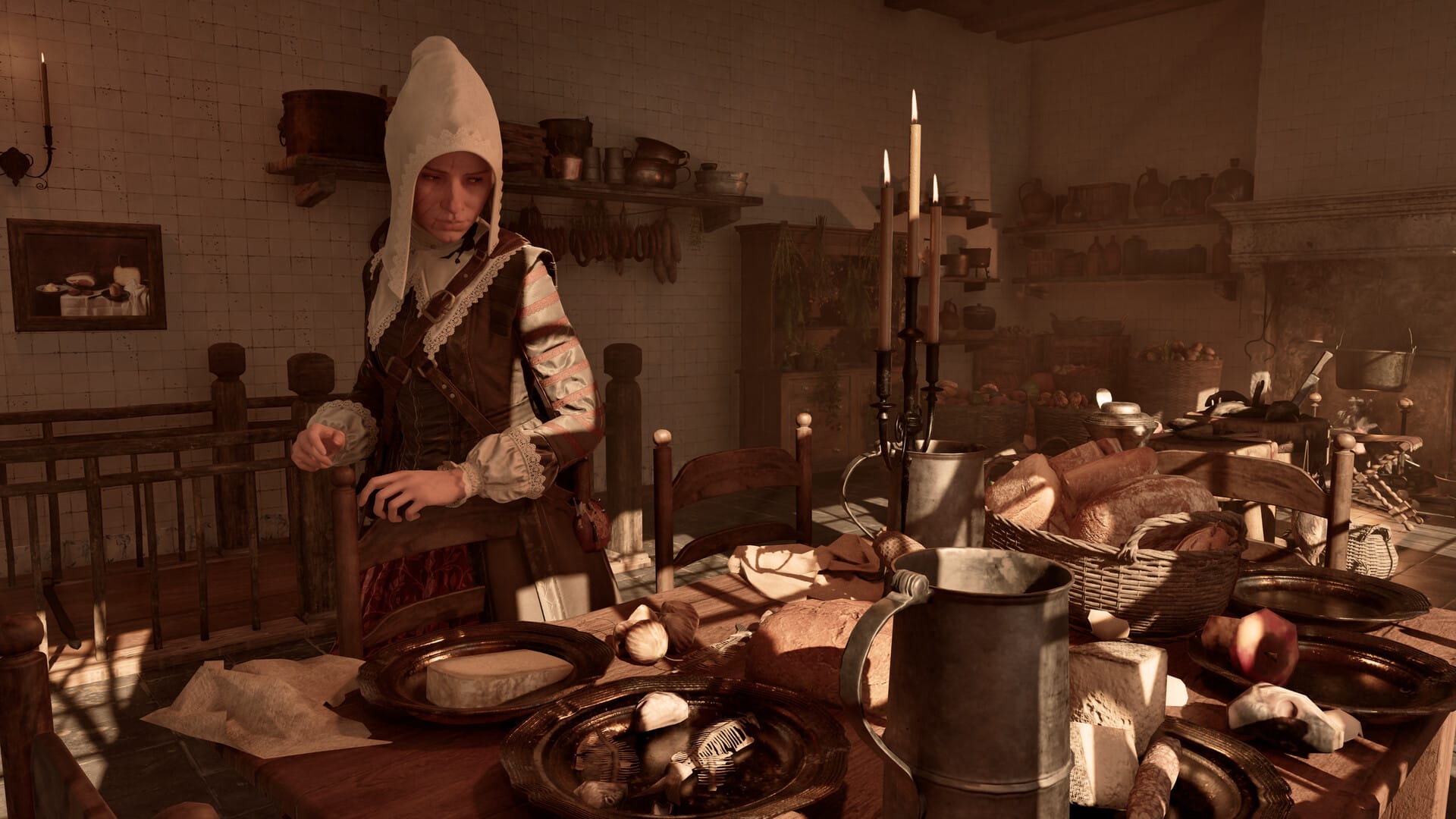
1666: Amsterdam, best known as the brainchild of Assassin's Creed co-creator Patrice Désilets before its reveal was marred by some impressively terrible AI art, has as of recent times “totally” moved on from AI. That’s according to Désilets, who, speaking with GamesRadar, claimed that his company had fired up the plagiarism machine “mostly at the beginning … in conception and pre-production.” Now, though, AI’s out of the pipeline. Hm, where have we heard this kind of thing before?
Oh, right, earlier this year from the developers of Blood of Dawnwalker, the vampire-flavored skulk ‘n’ stab from former Witcher devs that comes out this week. And also from the studios behind Tomb Raider: Legacy of Atlantis, the Steam page for which discloses that “AI-assisted tools” were used to support “some early exploration and temporary development content,” but that “any AI-assisted assets were either replaced or refined by humans in order to maintain the creative and artistic vision of the development team.” Oh, and from Larian CEO Swen Vincke at the very beginning of the year, who—while facing sustained blowback following an admission during an interview last year that his studio had been experimenting with AI—clarified that developers used the tech to “explore things” but that “there is not going to be any GenAI art in Divinity.”
At this point, a meta has calcified: Use AI, get caught and/or admit it, and then walk it back by saying that no AI-generated assets will appear in the final game, you’re done with AI for the time being and, actually, you never used it all that much to begin with, so really, what’s the big deal? Then the bad press dissipates, and you can move on with your life.
This should not be allowed to function as a get-out-of-AI-jail-free card, both because it’s a plainly disingenuous reaction to criticism, and because it doesn't hold up to scrutiny. Creativity is a process, one that begins with ideation and conception. Indeed, these are some of the most enjoyable parts of creating something; writers get to envision whole new worlds, artists get to sketch out their most deranged fever dreams, designers get to invent new genres and mechanics. It feels almost banal to say at this point, but that’s the last place where we want AI intruding. Unbridled human imagination does not need a pair of clumsy, cold hands leading it to water.
And even if the words, images, and designs AI produces don’t make it into the final game, its fingerprints still wind up all over the thing. Those are still AI’s malformed hallucinations being painted over by people. That is still AI effectively helping steer the ship, if its contributions really are constrained to a project’s early goings. It’s the video game development version of humans being trained not in any specific skillset, but rather in how to prompt AI to do it for them. After a certain point, that becomes almost worse than using AI to whip up an ugly in-game painting or two. Instead, it’s filling in perceived cracks in the foundation. It’s becoming the base on which everything else rests. I don’t care what studio heads say about individual assets; AI is absolutely in a game made that way.
This is a bait and switch, and it can’t become the accepted default. AI suffuses these games even if it’s not literally staring you in the face moment to moment. Execs and studio heads will keep trying to talk out of both sides of their mouth here. Don’t let them. Words need to mean something, or else AI will have truly won.
"Creativity is a process, one that begins with ideation and conception. [...] It feels almost banal to say at this point, but that’s the last place where we want AI intruding. Unbridled human imagination does not need a pair of clumsy, cold hands leading it to water."
Some time ago I visited a used book fair and came across this awesome piece of 80s scifi-asthetic.
This book is a collection of short stories by the Polish author Stanisław Lem originally published in 1964. Its English title is The Cyberiad. One story, about Trurl's electronic troubadour, turned out to be surprisingly topical.
Spoilers for the whole story follow
The inventor Trurl (revealed in other stories to be a robot) wants to create a machine that can generate poetry. He begins by obtaining several hundred tonnes of books to use as training data.
Trurl gets to work constructing the electric poetry machine. In the process they have to create massive data storage containers that stretch further out than one can see using binoculars. This is considered a necessary evil to get this great invention going.
The machine will not work as expected. As a last resort Trurl rips out all logic circuits and replaces them with "narsistors". Then things start working.
Trurl invites his friend Klapaucius over to test the new machine. They give it all sorts of weird and wacky instructions like "create a pastoral love poem that also contains mathematics and cybernetics". Basically they do a whole bunch of prompt engineering. They talk and behave exactly like people of 2021-2023 did when LLMs first appeared.
Eventually the machine causes uproar among poets and there are protests demanding it to shut down. These go nowhere in part because the media secretly love the machine. They are using it to create their own content for pennies and thus don't want to see it come to harm. As all of this is going on various people develop symptoms quite similar to modern day AI psychosis.
Things eventually crash when Trurl gets the machine's electrical bill, which turns out to be astronomical. He needs to get rid of the machine and manage to dump it on a visiting dignitary who takes it to his home planet where causes a supernova explosion. Trurl deems that to be sufficiently far away to not be his problem any more.
The difference between fact and fiction
In the story all the problems are caused by the fact that the machine's output is vastly higher quality than anything humans can create. Even the great Stanisław Lem could not predict that in reality the output would turn out to be mediocre garbage and still lead to all the same problems.
Even though the story specifies that the machine is given some "basic instructions" first, nobody tries to do a prompt injection attack on it. That would only appear almost 30 years later in 1993's Paranoia novel Title Deleted for Security Reasons. An earlier example may well exist somewhere, it almost always does.
 Log in