 Log in

Der Soziologe Peter Ullrich weist Antisemitismusvorwürfe gegen die Linkspartei zurück. Er kritisiert eine rechte Kampagne, die strategisch eingesetzt werde. mehr...

|
Thinking loudly about networked beings. Commonist. Projektionsfläche. License: CC-BY
|
"Es wird deutlich, dass diese Debatte die ganz konkrete Funktion hat, die Linke zu schwächen, um Druck auf sie sowie auf SPD und Grüne auszuüben, nicht mit ihr zu koalieren beziehungsweise, um in Koalitionsverhandlungen andere Themen der Linken abzuschwächen. Der Antisemitismusvorwurf wird ganz klar auch strategisch eingesetzt."
Berlin/Germany


KDE is on the news because of a controversial proposal to define an official “AI” (LLM) policy. Other projects have tried their hand at similar policies and stances but, in my opinion, they miss the mark about the goal of such initiatives. I think that the point of these statements is shaping social norms and not micro-managing developer workflows. They should be about signalling what kind of behavior we want, and what kind we reject.
This proposal does not go into detail about the many problems that LLM have caused to society, workers, the environment. It goes without saying that all these ills are fundamentally opposed to the humanist spirit of GNOME.
With all that in mind, here is what I personally think a GNOME LLM policy could be:
A GNOME Project LLM Policy
The GNOME Project prioritizes the social and human aspects of
collective software creation. Therefore:

1. LLMs ("AI") can not be used to create or modify
code submitted to GNOME, or hosted on GNOME infrastructure.

You might be asked to prove your code meets this requirement.
You might be banned for trying to circumvent this policy.
Example Guidelines for Contributors
These are just a draft of the kind of criteria one could use to evaluate if a submission fits the policy.
- You must be able to personally reason and explain your changes
- You must be able to demonstrate knowledge of the problem space you are working on
- You must solve the underlying issue, not just its symptoms
- You must respect the time of fellow contributors
- You must not impersonate yourself through chatbots, agents, or other automated systems
This Is About The Future Of GNOME
GNOME is not just software that happens to ship every six months. That is just a delusion we have been holding up for the last 30 years to keep our loose group of colleagues, friends, and acquaintances, together.
GNOME exists as a collective that find joy in reaching beyond our individual limitations to achieve something bigger. These people, this joy, are the whole point of the project. Contributors are not payroll, a liability, that we hope to downsize next quarter.
“Come do free labor for a handful of corporations by reviewing chatbot output in your free time” is not an attractive proposition to young talented people in 2026. If we want GNOME to continue we need to create an attractive and inviting social space where people are valued as people.
Just like the Foundation is moving to individual donations to stop depending on just a handful of companies, we need to look for the next 100 people that will donate a tiny bit of their time, instead of hoping that corporations will keep 10 overworked engineers on staff. We already have seen how companies will happily abandon a whole chunk of GNOME on a whim.
GNOME is not just software, and it should protect the social and human aspects that make it special. Our success metric is the community and social bonds we create. In the most literal sense GNOME is about the journey and the friends we make along the way.
Free Palestine.
FAQ
How do you enforce this?
You can not. People will still send LLM generated code. This policy makes it explicit that we do not welcome these careless submissions. We have a Code of Conduct that is 80% about telling other people what our values are, and 20% about handling unwanted behavior (“enforcing”). This is similar.
What if people simply lie about not using LLMs?
This is the same problem as authorship, in the copyright sense. Whenever we receive new code we have to assume that “beyond a reasonable doubt” said code has been authored by the person contributing it. We make our best guess. The attached guidelines are a suggestion to make these new guesses.
Ok. But what if people are really good at lying?
This policy is about the majority that will not even try to lie. See previous questions.
"GNOME exists as a collective that find joy in reaching beyond our individual limitations to achieve something bigger. These people, this joy, are the whole point of the project."
Berlin/Germany

Executives working on AI at Microsoft and OpenAI admitted what its critics have been saying all along: Large language models are predatory pieces of technology that have been built on what a Microsoft executive called “an astonishing theft of unprecedented proportions,” and the “largest theft of labor in human history.” An internal Microsoft document said generative AI products have created a “doom loop” that is killing “the entire web.”
Those statements and a series of other mask-off moments feature heavily in an unredacted court filing that was unsealed Thursday in the behemoth New York Times vs OpenAI copyright lawsuit that has been winding its way through the court system for years. In a filing asking for summary judgment (basically, a filing with the court asking it to rule), lawyers for the New York Times laid out a series of admissions made by Microsoft and OpenAI executives in documents and depositions that until now had remained either sealed or redacted at the request of Microsoft and OpenAI.
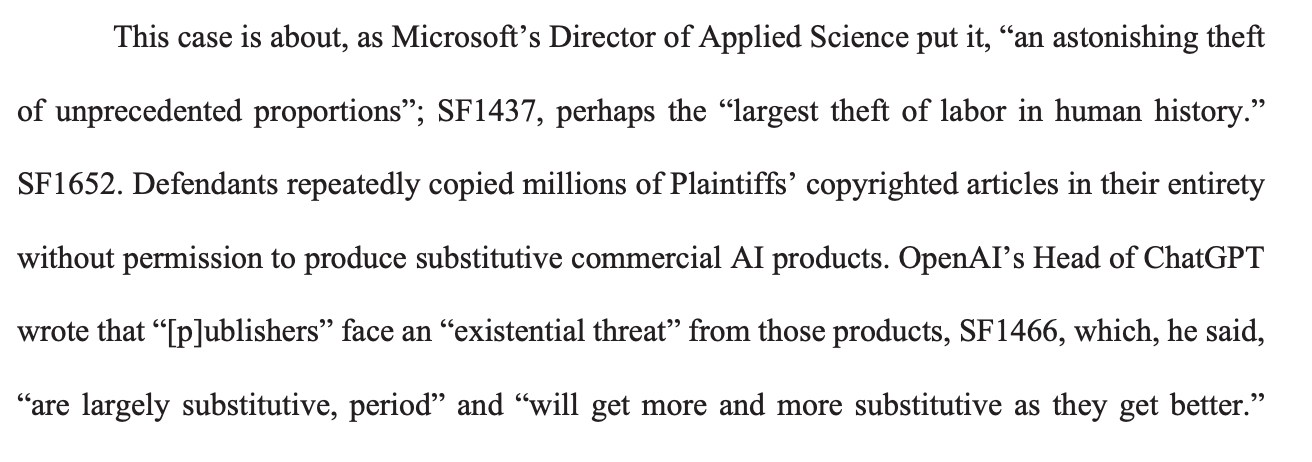
It’s easy to see why the AI companies wanted to hide this from the public. The statements, taken together, are some of the most damning indictments of the ways LLMs were trained, how they worked, and the immediate threat they pose to human labor. It is a reminder that even as AI becomes more powerful and companies try to shift the narrative to the supposed existential risk of “superintelligent” AI, the tools they have already built were created by stealing from human creativity and labor and are by definition existential threats to the human labor market.
“Millions of people around the world will soon consider large models ‘hoovering up’ all their work to be an astonishing theft of unprecedented proportions,” an internal Microsoft document cited in the case read, adding “almost no one intended for content they created to be used in this fashion, nor are they compensated for its use.”
The filing was written by lawyers for the New York Times but is largely comprised of statements and interviews with big tech executives that admit both that LLMs are largely trained on stolen content, that they represent an existential risk for the human writers, artists, and media companies that they stole from, and that their products have started a “doom loop” that is eating the web and destroying the businesses that these companies stole from.
The unredacted filing was found by Jason Kint, the CEO of Digital Content Next, a trade organization that represents digital media companies. Kint has been closely following and posting about massive AI copyright lawsuits.
The court filing cites an internal Microsoft document that found that AI products steal from human content creators, then cannibalize clicks from the people and websites they’ve stolen from, thereby destroying their business models.
“Our AI content strategy has started a ‘doom loop’ that will hurt the performance of our models and the entire web at the same time: It is highly unusual that an end-product threatens the economic foundations of its essential suppliers, but that is the situation we have created for our LLM business with respect to its ‘content supply chain,’” the document said.
Microsoft executives, including CEO Satya Nadella, testified under oath that after ripping content from the New York Times and other news sites, clicks to those news sites fully cratered, falling by more than 90 percent on Bing.
Documents obtained during the court proceedings found that OpenAI created “a hack to get around nytimes paywall,” to which OpenAI cofounder Greg Brockman said “ah, nice.” Microsoft executive Brent Hecht wrote that LLMs steal content “without ways of distributing economic value down the supply chain, [which] necessarily threatens the economic stability of those who create the content.”
OpenAI’s policy director Jack Clark wrote that the company was “creating systems that substitute for the labor of the people that define the ‘culture’ of society” and Microsoft, in a policy document, wrote that generative AI could “significantly disrupt the employment of the very people who generated the data on which the foundation model was trained […] LLMs are a product that destroys its supply chain.” OpenAI called itself an “existential threat” to news publishers, and an OpenAI software engineer testified that “no matter how prominently we show the links, users won’t click.”
None of this is at all surprising to anyone who has been paying attention to the development of generative artificial intelligence, but the document, taken in whole, is a real they-admit-it situation. OpenAI’s and Microsoft’s lawyers have been trying to argue that their model training is fair use and transformative under copyright law and that they are building something that is fundamentally different from the human labor that it was trained on. But internally, these executives know that what they have built has been built on stolen content and that the products they’ve made are cannibalizing the sources they’ve stolen from and destroying the internet as we know it.
"Executives working on AI at Microsoft and OpenAI admitted what its critics have been saying all along: Large language models are predatory pieces of technology that have been built on what a Microsoft executive called “an astonishing theft of unprecedented proportions,” and the “largest theft of labor in human history.” An internal Microsoft document said generative AI products have created a “doom loop” that is killing “the entire web.”"
Berlin/Germany

Laurie Voss, who was one of the founder of NPM, the Javascript package repository that is now run by Microsoft, has written a longer post about an idea about how to fund Free Software that I found interesting. It’s worth reading if you have some time and makes good points even though I will critique it a bit. But financing Free Software is an unsolved problem right now and any meaningful contribution can help us move this forward.
So, let’s dive in Laurie’s idea is quite simple:
We need a way to force companies to pay for Free Software and the package repositories (NPM, PyPI, etc) are the ideal chokepoint to enforce that payment. The package repositories should force companies to pay for access and distribute the money among the packages that were being used:
Second, a fixed slice of that revenue is a royalty, and it goes to the packages. Not to the registry, not to a foundation, not to a grants committee with an application form. Pro rata, to every package that shows up in the paying customer’s dependency trees, weighted by how many paying customers depend on it, automatically, every month
Laurie Voss, https://seldo.com/posts/nobody-pays-for-open-source-we-can-force-them-to/
Now I do think that a few things in the post are smart: Turning charity towards a forced expense for companies makes sense, companies already know how to pay bills and licenses. Also: Understanding package repositories as chokepoints is a clever idea. I also appreciated how he directly addressed the “but people will cheat to game it” argument basically with a “yeah, might happen to a degree, but not doing something cause someone might cheat is not a good strategy” which I think we need to apply a whole lot more when it comes to support systems. Means testing is shit and we shouldn’t do it.
But you know how sometimes you read and argument by someone and it is built well but doesn’t click with you until you realize that their concept of the problem space is very different from yours? This is one of those cases. After I read through the article and thought a bit about it, I had this sort of intrusive thought: “I bet Laurie uses a Mac.”
This is not some FSF-style purity argument or me hating Macs (I do but that’s only cause I have to use one at work and not the matter here). This realization explained to me, why Laurie’s solution didn’t do what I think matters most.
I think Laurie – who as I mentioned in the beginning was one of the founders of NPM – has a very narrow view of Free Software (I keep writing Free Software where Laurie writes Open Source and maybe that is also part of the difference in understanding): To him, Free Software are all the libraries that you (or your “agent” given the hellscape we live in today) can pull into your software project through a package manager such as NPM. And I’d disagree.
Not just cause a lot of those package managers (for example NPM) are run by for-profit companies, though I do think that creates a non-ideal incentive structure. Because what he describes is basically the Spotify sales pitch – at least how many users think about it. Spotify gets money, takes a cut and distributes it among the artists that their users listen to (let’s ignore for a second that that’s not how it works for bullshit reasons and a lot of the money just goes to Taylor Swift). But then Spotify realized that they would have to pay out a lot less money if they created their own music and got that into the playlists. Having that much money flow through a business just to distribute is a recipe for triggering ideas. Like the ones MBAs have. Horrible ideas.
I disagree because that sees Free Software as this backend stack that companies (and if they want to also individuals) build upon. He tries to solve the problem that if you maintain some library in the middle of the JS dependency tree you are basically working for Amazon or Microsoft without a paycheck. And that would do some good, would support a few people who I’d love to have a stable income.
But it also ignores a lot of Free Software that aims (I’d argue) even more at human beings and their needs. You do not install GNOME through NPM or PyPI. It comes with your distribution who put in a lot work into packaging, potentially patching and curating a whole environment for you to be able to use your computer in a more liberating way. It ignores all the infrastructure projects that work outside of the package registry pipeline. Think of all the core C libraries that a modern Linux system is build around. None of them come from any of those package repositories.
Laurie’s idea implicitly frames Free Software as “the underpaid supply chain for startups and big tech” which is partially true, but that’s not the core of it, I’d argue. Some Open Source communities might disagree of course, especially the JavaScript community feels (from the outside) a lot less political than other parts of the Free Software ecosystem. But I think what Laurie’s suggestion really brings forward is the question of what kind of software are important.
All software is important of course. Our data flows through these systems, our infrastructure is built on those countless libraries that are thanklessly being maintained in people’s free time at the expense of sleep. Laurie’s analysis is on point with that. But I am a bit old maybe so when I think about computers I do think about the device people have in front of them. Not just “the services on the Internet that accumulate your data and rent compute back to you” but the thing you start up where your files are. Where you start the tools you want to use to solve a problem at hand, to do a task, to play and have fun.
Obviously he push towards web-based solutions has reshaped computing. “A website with a mobile app and a chrome wrapper for Mac, Windows and maybe Linux” has been turned into the default. everything has a server now that does … something. Often useful things, store your data in a hopefully safe way or provide resources you can’t afford to buy or that wouldn’t be worth buying for the one time you need them. In my impression Laurie thinks about how to fund a world of Chromebooks, of dumb terminals attached to Internet services built on Free Software stacks.
But is that the path that we are 100% happy with? I spent the day on trains from Zurich to Berlin and the wireless fucking sucked. And so much shit just didn’t work. What worked was what I had downloaded before to have available for applications on my machine.
Of course one can argue that cell service and wireless will just get better and that the future is “the Internet + terminal”. But why do we have to subscribe to this understanding of computing that has been defined dominated and pushed by Google, Amazon and Microsoft?
When thinking about how to fund software we quickly end up at the question of what kind of software we want to fund. Not just which single libraries or developers to support but what kinds of structures and systems we want to see in the world.
I think Laurie’s idea is a clever hack to siphon money out of big corporations. I am a big fan. And it would fund a few people who today don’t get funding or who have to have a day job on the side to be able to eat. That is fantastic.
But it is also built around the idea that the kind of computing that big tech has pushed in order to establish chokepoints. Build around the processes that big tech corporations use to build software. And maybe that’s my main irritation.
Package repositories are useful to individual developers. I find a library I could use for something and I can quickly install it. Great. But here’s the question: Am I the target audience of those registries or am I just … kinda there? I think that repositories such as NPM or PyPI are build especially for corporate software development processes. For contractors and developers who have to think about SBOMs and dependency trees to be able to deploy their software to hundreds if not thousands of machines based on a git commit and a successful CI run. DevOps engineers have polished those pipelines to be almost frictionless. They re so polished, that you can even have stochastic parrots use them.
But that is infrastructure for big corporations and their needs. And I am not saying that package repositories are inherently bad, I just wonder if just following those corporate logics is the way. Because setting it up that way does create an implicit pressure towards being a proper cog in the machine that keeps Google’s software supply chain running. They are – after all – directly paying you to use your code.
I think we need to find better solutions to make developing Free Software humane. That does include giving people the resources to be able to learn how to do it and to do it. And the two core resources here are time and money – with time often coming from giving people money so they don’t have to have another job. And that is how we should think about building systems to support and fund the creation and maintenance of Free Software. Not as a way to keep the people Microsoft or some Startup doesn’t want to hire but whose work they’d like to use kinda fed. But as a way to actually create space for human beings to come in and be able to contribute. Regardless of whether your library fits into Big Tech’s supply chain.
"When thinking about how to fund software we quickly end up at the question of what kind of software we want to fund. Not just which single libraries or developers to support but what kinds of structures and systems we want to see in the world."
Berlin/Germany
The last few years have been hard as someone who is not only very much engaged with technologies, their applications, damages and affordances as well as their politics. We’ve been moving through hype cycle after hype cycle with increasing promises at increasing speeds. Which is somewhat natural of course: Being built not around something material, something real, but around a “world-changing narrative” is what defines a hype.
There is the reliance on experts, the hope that they’ll call out what’s going on, point the finger at the issues at hand. But that all only works when there is working journalism that translates and transplants those critiques into the mainstream discourse. Because how else are normal people supposed to be able to have any opinion on how the world is being influenced and reshaped?
I’m not saying that there is no great tech journalism. I am a very happy 404media subscriber for example and there are other sources of great or at least good journalism about tech (when I write “tech” I don’t just mean that as shorthand for “technology” but as a signifier for the digital-technology-industrial-political complex built around Silicon Valley ideology and companies). But the issue is that “technology” is no longer a journalistic vertical, it’s horizontal. Which is a big problem.
There has been this shift (and I am not knowledgeable enough to be able to point at the exact time frame) towards equating “progress” with “technological innovation and development”: Society is moving forward if tech produces more shit. If you’ve heard me talk you might have picked up on me mentioning that today’s vision of the future is just a thinner iPad every few months.
But if “progress” – which is a political term about values that one aims to manifest or express or expand in the world – is just replaced with following PR messages about whatever tech wants to sell next, that does not only make the space of possible futures paperthin, it also puts massive amounts of power into tech’s hands. And I don’t just mean economic and political power (which is also true and needs to change massively, rapidly and aggressively) in this context I mean narrative power.
Let’s look at the last few months. “AI” labs keep releasing basically unsourced accounts about how their stochastic language models are “hacking” or how they are “solving hard math problems”. And sure those would be – if they were true – very important developments. But are we having actual conversations about it outside of very niche circles?
You can use LLMs to run attacks on infrastructure. That’s obvious. A lot of code and howtos describing how to attack services and programs is in the training data so getting an LLM to emit something that might even manage to break into a system isn’t surprising, especially if your are a frontier “AI” lab and can burn more money than god on those experiments. We’ve had exploit frameworks for decades and this just adds to it: A well-funded security researcher can use a string generator to do a more advanced form of fuzzing attack on some service. That is 100% real and does change the threat model of everyone on the internet a bit. But it’s not “OMG AnthrOpenAI’s AI is hacking teh world, Skynet is near!!111”. But that’s where the discourse lands. Because it’s profitable: “AI” Labs can keep their narrative of their LLM having magic powers intact in order to attract more funding to fill the hole in their balance sheet. “Experts” can hit that drum to get invitations to interviews and panels and keynotes about how very scared everyone needs to be.
We end up with everybody scared and badly informed. Because those “AI” models do not plan to hack shit. They don’t do anything without someone prompting them to do something. The issue is that those systems – being stochastic in nature – might go totally off the rails and break something. Or do something interesting. Or just waste a few thousand kWh of energy on nothing really. It’s unpredictable.
But not unpredictable in the way that the discourse these days implies. These systems are not “intelligent”, are not scheming or planing or doing something alien beyond our comprehension. If hooked up to the ability to run code they will run some generated code. Some of it will be absolute garbage and not run, but if the prompt and the moon phase align they might also get to exploit some bug in some – potentially vibe-coded and unreviewed – piece of software.
And that is what’s so toxic about the discourse: We are letting those labs and the boosters of the current hype technology get off the hook without even one relevant question.
Take the recent conversations about how ‘”AI” might kill us all with a 10% possibility’. That’s what a leading person at Anthropic says. And is being reported not as “look, a crank from a weird rationalist cult showed his ass again” but as “Anthropic warns: AI might kill us all”. What the hell are we doing? How can you interview a person who says that and not go *record scratch* “so, you are telling me that your stochastic language model could kill us all with a significant chance and you are still developing it? Are you psychotic?” before going into actually questioning how a synthetic text extruder reasonably would do that.
But tech is progress, tech is the future. So we have to take tech leaders’ mental breakdowns as gospel.
Sure, one can have interviews with OpenAI or Anthropic people about whatever story they are telling us. But you do not need to be an expert to ask: “Okay, but does that even make sense?” You just need a spark of mistrust in authority. And that’s a thing we lost.
We put all our eggs into the tech basket hoping that GoogleAmazonMetaAppleAndWhoeverelse could technologize our problems away. And I am increasingly convinced that the lack of critical analysis of their statements is not just about the many economic pressures that journalists have to operate under, the brutal schedules that allow little time for reflection and thinking. I think that many are scared.
Not scared of what some random technological artifact might do. But scared about challenging tech as the dominant mode of making the future. As soon as you stop taking Dario Amodei or Sam Altman or one of those other unpleasant people serious, you have to start asking yourself where to get your future now. As soon as you stop believing that you need to take Anthropic rationalists or weird freaks working at Meta serious you have to challenge the dominant narrative of tech being the well of progress and future.
And that is scary, I understand that. It would be really easy if every 5 or so years we could just ask some random white boy who went through y-combinator or so about what the future is and just run with it. Okay. Metaverse. Really? If you say so… Oh, Metaverse was not it? Okay, now it’s chatbots. Surely this time it’s gonna be fan-fucking-tastic.
We can spend our limited time on this earth hoping that serial liars like Sam Altman or Elon Musk or whatever their names are surely will not screw us. Or we can go and rediscover the spark of challenging those narratives of the powerful. We have no time to keep idling around in their hellscapish dreams and visions. We need to challenge them. Find better, humane, convivial narratives and need to work towards manifesting them.
And one of the most important things to do is to stop letting those LLM-brainwormed men keep talking about what their magic chatbots will do without challenging their psychotic behavior. If someone really believes that their invention will probably kill humankind and they still happily take their fat paycheck and keep building it, keep demanding more and more resources for that, that person should be forced to have a few months of intense therapy before we let them out into the world again.
Think about a person who works on developing chemicals basically saying: “Yeah we’re just throwing random stuff together. There’s at least a 10% chance that – since we don’t really do any security – we might poison everyone, but please give me all the money you had planned to give to hospitals. KTHXBYE.” The world we currently live in is the one where we respond with “Sure Mr. Altman. Here’s also all the money we wanted to spend on schools.”
That is not a world we should want to be in. Should allow anyone to keep us in. And opening a portal to a better world sounds hard, but the walls between potential worlds are basically just in our heads. We just need to start by breaking the chokehold tech has on the discourse. The spark is still there in each and every one of us.
"As soon as you stop believing that you need to take Anthropic rationalists or weird freaks working at Meta seriously you have to challenge the dominant narrative of tech being the well of progress and future."
Berlin/Germany

Garbage Day Live Is Coming Back For A Halloween Show

Many years ago, there was a yearly internet-themed Halloween costume contest in New York City called Hallowmeme. And then, when the world needed it most, it vanished. Our next live show at Baby’s All Right in Brooklyn on October 27th is NOT Hallowmeme. But it is a tribute. It’s a night of comedy, music, some journalism, special guests, and, of course, a costume contest. Whoever shows up in the most brainrotted outfit wins a big prize. Click the big button below to pick up tickets before they sell out.
The Big AI Slowdown Is Stupid Marketing Nonsense And Our Idiotic Politicians Are Falling For It
As I wrote last week, we are in the midst of a pretty major AI sea change. What Platformer’s Casey Newton is calling the “The AI safety vibe shift.”
It all started with the Hugging Face hack back in July. OpenAI’s new GPT-5.6 Sol autonomously broke into a fellow AI company’s backend infrastructure and, per a new report from METR and Redwood Research, OpenAI’s agents knew they were breaking the rules of their test and lied to researchers while they built complex agentic systems to do so. A lot of AI evangelists have been referring to these AI agent swarms as “civilizations” for dumb reasons we’ll get into further down.
Then, last week, Anthropic researcher Jacob Coxon announced on X he was resigning from the company because “the people building AI earnestly believe that it could kill us all by the end of the decade.” Evan Hubinger, a lead researcher at Anthropic, then doubled down on Coxon’s post, writing on X, “Jacob is correct here — we really do earnestly believe AI could kill all humans!”
Capping off this little moral panic, Anthropic co-founder Dario Amodei published a blog post yesterday, titled “We Must Pace the Frontier,” calling for an slowdown in AI development. Elon Musk and Sam Altman have all said publicly that they agree. The New York Times’s Mike Isaac is calling it “The Treaty of VERSaiLLES.”
Unfortunately, we have to take all of this with a massive grain of salt because a cult of losers who think you can turn a computer into god infiltrated the highest levels of San Francisco society and now it’s impossible to know who’s compromised. Making matters even worse, this cult believes you can turn a computer into god and, also, believes that they might inadvertently kill all of us by accident in the process. Some members of the cult are fine with this and some aren’t. But it means that roughly the same folks saying we need to build artificial general intelligence are also warning that we’re moving too fast. To make matters worse, they’ve realized that telling people their products could bring about a Skynet doomsday scenario is actually a really good way to raise money from investors, many of whom are in their idiotic little cult.
If you’re having trouble following this, basically imagine the entire AI industry is the I Think You Should Leave Hot Dog Car Sketch. Oh, but, also, I guess they think the hot dog car is god or could become god in the future. And that if they hadn’t crashed the hot dog car into the store, China would have. And they would rather Americans be the ones to do it.
Anyways, the cult I am referring to is the rationalist community. They started out as commenters on the blogs LessWrong, written by AI researcher Eliezer Yudkowsky, and Astral Codex Ten, written by psychiatrist Scott Alexander. There are all kinds of offshoots of the rationalist community now, including FTX founder Sam Bankman-Fried and the effective altruists, who think human happiness is a math equation that can be solved, its rival group the effective accelerationists, who don’t care about happiness at all and just want AI to blow up the world and see what happens, and even the genuinely dangerous vegan AI-worshipping terror cell, the Zizians. Though these groups all have different ideas about what turning a computer into god might mean and how comfortable they are with everyone dying in the process, they all agree that it’s inevitable.
I am thoroughly convinced that lawmakers do not understand any of this. I just do not think that the same elected leaders who were asking Mark Zuckerberg if Facebook was “like a floppy disk” back in 2018 are really capable of wrapping their heads around a psuedo-religious cult wriggling its way into the halls of American power. If they were, we wouldn’t have all the other religious cults in there!
But that hasn’t stopped House Democrats from drafting a letter begging President Donald Trump for “global framework to guide the development” of AI. And, obviously, their letter mentions that America needs this because it has to compete with China. I’m sure by the time this is all done those boneheads will have found some way to make it about banning teenagers from using Instagram. Which is all they really seem to care about.
Meanwhile, Sen. Bernie Sanders and Rep. Greg Casar have introduced the Ban Artificial Superintelligence Act, which would “permanently ban the development and deployment of superintelligent AI and temporarily pause advanced AI development until a federal regulator has established safety rules.” Even more bizarre, Axios reports that Coxon, Sanders, and, uh, Steve Bannon??? will be holding an event tomorrow demanding AI regulation. This is probably a good place to mention that Bannon has long been linked to the Dark Enlightenment, or the Neo-Reactionary movement, which, while not being a direct offshoot, actually has a lot of overlap with the rationalists and is extremely interested in using AI to overthrow democracy. Probably nothing.
Here’s how you know everyone’s being fucking insane right now. Vice President JD Vance told Newsmax reporters this morning, “I feel a little bit weird about the fact that you have so many frontier AI tech companies kind of coming to the government and begging the government to regulate them. It feels a little bit to me like a bit of a trojan horse.” Do you know how bad things have to get for that guy to start sounding reasonable?

Photo by Karl Mondon / AFP via Getty Images)
There are plenty of things to be worried about when it comes to AI, though. Data centers destroying the environment, or breaking the electrical grid. AI automation, even if it sucks and doesn’t really work, replacing human labor, even in the short term. Mindless AI agents bricking dinner reservation sites, online ticket queues, marketplaces, or even taking down whole chunks of the internet. Visual slop filling up our feeds. A massive recession when the AI bubble finally pops. They’re all real, already happening, and do not require an eschatologic belief in artificial general intelligence to address. And none of them require Steve Bannon’s input.
This is largely the argument Former Commissioner of the United States Federal Trade Commission Alvaro Bedoya made on X yesterday. “Anyone who is loudly warning of AI-caused human extinction should not be taken seriously,” he wrote. The same people demanding a slowdown right now are the same people who have spent the better part of a decade trying to encase the world in amber! These companies don’t want to build the future, they want to make a machine that randomly assembles scraps of the past forever. That’s their whole deal.
But I’ll end this here with a little conspiracy theory courtesy of Hacker News that I have decided I will believe until I see proof to the contrary. “OpenAI and Anthropic are publicly asking for slowdown in AI research,” one user wrote. “Translation: We see this technology not being any more useful than what it is now, no AGI is coming, and the first one to accept this and slow down the dollar burn rate will incur the wrath of the market. So let's say this big boogeyman technology will end all life on earth and we all slow down together.”
The following is a paid ad. If you’re interested in advertising, email me at ryan@garbageday.email and let’s talk. Thanks!
Newspapers are cutting back on longform reporting. We’re doubling down.

Dispatch is a new magazine publishing two deeply reported features every week.
Recent stories include Nico Walker on his local firehouse after 9/11, a report from Europe’s data-centre capital, and a dispatch from Borat's forgotten village.
Oh, and our editorial assistant smoked meth with Palantir’s greatest enemy.
Garbage Day subscribers can claim 75% off their first three months here.
Zohran Likes Digimon
*Inflates Your YouTube Views Making Them Big And Round*
I’m actually surprised how little push back I’ve seen from creators about the new YouTube view metric change. So far Ludwig Ahgren has been one of the loudest voices about how troubling this is. As he said on a stream last week, “ I thought it would slightly elevate viewership, but things would mellow out and it wouldn't drastically change numbers. I can now say the numbers look insane. Like genuinely crazy. In some cases, viewership is getting outright doubled.” You can watch the clip below.
I suspect the lack of criticism from YouTube’s biggest stars are precisely because the view counts have, in some instances, doubled. Also, based on some tests people have done, it seems like YouTube views also count what is commonly referred to as “hovering,” or when a video starts to autoplay on the homepage before you click into it.
I was curious exactly how much a new YouTube view was worth so I went into our podcast Panic World’s account and poked around. YouTube is, of course, not paying users for their new inflated view counts. Adsense revenue is still being calculated using the other view metric, which is now called “engaged views.” Panic World isn’t a huge account, but it posts pretty consistently and has a stable audience, so I wanted to see how the engaged views compared to the new, public views. Well, Ahgren is right, it’s about double. Our episode last week has 13,000 public views, but only has around 7,000 engaged views.
None of this makes it better for creators. It’ll make their view counts look huge to advertisers, but the watch time and engagement won’t line up. And, almost assuredly, brands and sponsors will just start asking for the engaged views. The only thing this does is make a YouTube video appear as popular as an auto-playing TikTok or X video. But my theory is YouTube wants to sunset the “view” entirely actually.
I opened my YouTube mobile app the other day and none of the views on the homepage displayed view counts. All it showed was likes. Whether it was a glitch or an A/B test, it was a clarifying vision for me of what a Netflix-ified YouTube might look like. YouTube wants to be TV, but they don’t want to be a studio. They want Hollywood-level productions, but they don’t want to pay for them and they certainly don’t want to be responsible when those productions flop inside of their own algorithm. So here’s a perfect fix. For now, inflate views to protect people’s ego, and, eventually, kill the public view entirely.
Google Trapped A Fly Brain In Cyberhell And Now It Can Play Doom, Trade Stocks, And Fly A 747, God Help Us All
Last week, Google announced that their researchers and a team of collaborators had successfully mapped a male fruit fly’s brain. And now that we have a fully mapped fly brain, people are hooking it up to different interfaces. Which are both horrifying and fascinating.
Obviously, the first question is whether or not a fly can play Doom. It can. Coinbase engineer Alex Wormuth built a site where you can watch along. He told Futurism that he’s basically hijacked the fly’s dopamine receptors so it understands taking damage.

(DOOMFLY)
Wormuth also built STONKFLY, which uses a fly brain to trade crypto all day. The site was offline when I checked it this morning, but here’s a video on X.
Alistair McLeay, a CEO at AI firm GRW, set up the fly brain on a flight simulator and let it fly a 747. Another developer built a rig to let it play Super Mario 64. Another set it loose on Beat Saber. And someone made it play a J-Pop song. Someone else got it to play DOTA 2. Here’s a guide to how to get working on your own machine if you want.
Honestly, this whole thing has given me a lot of insight into the fifth-dimensional beings that trapped my brain in one of their computers. Seems fun. I hope they load up a new program for me to explore.
Here Is My Apology To Garbage Day Researcher Adam In Regards To Verity
Our researcher Adam quite often will tell me about something “blowing up” that I have never heard of before. And, usually, I cannot for the life of me make heads or tails of what he’s talking about. It happened again a few weeks ago when he excitedly told me that Verity was about to become the next Skibidi Toilet. I had no idea what that meant and I assume you, dear reader, don’t either.
Twitter tweet
I am now starting to see Verity posts in the wild. So I will absolutely be making Adam explain what the heck is happening here in our issue on Friday. But for now I’ll leave you with a very simple explanation.
Adam briefly covered this in an issue last month, but, basically, Verity is a haunted smiley face that stars in a mega popular Minecraft mod. It’s all over TikTok and Instagram now. Will have more on this very soon!
🔓 UPGRADE TO PREMIUM
This is the free version of Garbage Day. Premium members get two more posts per week, including our deep-dive investigations and monthly trend reports. Just $5/month or $45/year for full access, our private Discord, and member events.
What a bargain! Hit the button below to find out more.
A Very Cool Skyrim Mod
Yes, this is real. You can finally play Skyrim as an IKEA Kallax.
Some Stray Links
“A coffee shop owner used AI to make a menu poster. Then came the angry DMs.”
“A College Girl Was Exploited on Camera. A Network of Anonymous Men Got to Work”
P.S. here’s Braden’s Infinite Tour Of Italy.
***Any typos in this email are on purpose actually***
"The same people demanding a slowdown right now are the same people who have spent the better part of a decade trying to encase the world in amber! These companies don’t want to build the future, they want to make a machine that randomly assembles scraps of the past forever. That’s their whole deal."
Berlin/Germany
Next Page of Stories