Thinking loudly about networked beings. Commonist. Projektionsfläche. License: CC-BY
2660 stories
·
144 followers

Power grab

1 Comment

Omarchy should not matter. But sadly it does. As a power grab.

If you don’t know what Omarchy is here’s the short summary. David Heinemeier Hansson, creator of RubyOnRails, owner of a software business and millionaire, decided a few months ago to go all in on Linux and – because that’s just his MO – thought that turning his setup into a project made sense. Omarchy is just that: A pretty standard Arch Linux distribution with a handful of configuration files, that Heinemeier Hansson (or DHH as he is often called) wrote, or vibed or whatever. There is nothing wrong with this, custom, opinionated special purpose distributions have been part of the Linux culture for a long time and provide a lot of value and experimentation that sometimes even flows back to the original project. In a way Ubuntu Linux is just that to the basis Debian.

There’s also nothing wrong in more opinionated software – quite the opposite. I do think that RubyOnRails and similar frameworks gained traction especially because they do have a clear idea of how they see the respective problem domain. There’s even the statement “There should be one – and preferably only one – obvious way to do it” in the Zen of Python. Having a strong point of view is not a bad thing in software or in general. The problem is the kind of points of view DHH has.

I don’t want to go into all the gritty details here, Brennan Kenneth Brown did a great job with their article “Normalized Fascism in Open Source: $12 Million Given to DHH“, but here’s the short version. DHH is a racist and a fascist. He recently wrote articles on how there are [Content Warning: massive racism] too many brown people in London these days. In July he wrote an [Content Warning: Racism, anti-romanism] article comparing Roma communities (using a slur for them) to “wolves” that should be “shot”. His X account is also know to be “edgy” in a similar way. A few days ago he posted sort of a manifesto for his set of config files:

Screenshot of an X post (url: https://x.com/dhh/status/2098043643395277095) from the account @dhh saying:
Unite the nerds
Hold the line
Have some fun
Beauty is truth
Heritage is duty
Command is service
Welcome the agents
Perfect the computer
Own the machine
You’re somebody now

There’s even a longer version on the website. Even without a strong background in antifascist literature or history this reads like a fascist creed. About unity and identity. About “holding the line” (against codes of conduct and the rights of marginalized people as the website explains). About how there always needs to be a strong leader who makes the decisions. Given DHH’s other writing this is not a misguided joke, this is how he thinks about the world.

I began this text writing “Omarchy should not matter” but I have not explained why it does. It’s surely not about user numbers (it’s a clunky distro aimed at people who love to cosplay hackers). But it is about power.

DHH has used his connection to CEO’s of tech corporations and his position as influencer to collect up to now above 18 million dollars of funding for Omarchy. He uses that money not for himself (he has enough of that) but to fund certain pieces of Software he uses in his distribution. Like for example the window manager hyprland whose main developer the Omarchy money now funds. What is “Vaxry” known for outside of a niche window manager? He runs a community based around LGBTQ discrimination and participates in that (see the short summary on Drew DeVault’s “Weird Little Guys of FOSS” list). His bigotry is so consistent that he was banned from participating in the Freedesktop.org community where all the other developers of window managers and the free software desktop stack collaborate. And it was long before DHH funded him.

One could see a world where a CEO using his connections to drum up some funding for free software projects would be a good thing. But that’s not the world we live in I am afraid. DHH got 3 million USD from Digital Ocean (a cloud provider) for Omarchy. Basically at the same time where Digital Ocean cancelled their support of Flathub and GNOME that amounted to a value of 50 USD per month.

DHH is using his position and his influence to accumulate donations that he then can distribute to projects that align with his fascist worldview and ambitions. And in a time where many important projects and infrastructures are strapped for cash running just on the goodwill of a handful of people that is increasingly dangerous. Not because its corporate money – a lot of funding for open source comes from corporations, they are after all who are sucking up all the surplus from people’s labor. It’s because this amount of money gives him power.

The Omarchy foundation will be where projects in desperate need of funding will be pointed. And will a project focused on human rights and social justice get funding from our fascist overlord? What kind of pressure can that exert on projects who have to decide to either die due to lack of funding or kill their code of conduct?

An open fascist is building one of the bigger sources of funding for open source fully under his individual control and sucks up a lot of money that otherwise might have gone to liberatory projects. Community projects. Antifascist projects.

And that is why Omarchy matters. Sadly. Not because of its technical merit (even though those fascists love to use the “merit” argument to fight human rights) but because of its leader, his connections and his ability to accumulate financial power. Without anyone in that ecosystem saying anything about how that leader operates and talks. And you might know the saying: If there’s a Nazi and 10 folks sitting together at a table and nobody says and does anything? There’s 11 Nazis at that table.

Omarchy got a lot of recognition recently. Not only by corporate donors but by Youtubers and other tech influencers who kept praising it and nudged people (who might not know about DHH’s exploits) towards testing it. To become “a hardcore linux user/dev” or whatever other chauvinist argument they made. This makes it dangerous.

Running Omarchy means contributing to this dynamic. It means willingly integrating oneself into a fascist community. Legitimizing it. Supporting it. Omarchy is a fascist project that normalizes fascist thinking for everyone entering that community (even unknowingly). The baseline has to be not to use that system. And as people who believe in human rights and dignity, in community and a tech world that can be better we need to oppose Omarchy. Need to make sure it gets no seat at any table. Support projects who actively refuse to collaborate. Support projects who care about human rights and flourishing. And do not do business with the companies who willingly support fascists.

Siamo tutti antifascisti!

(Share this message about Omarchy [or some other similar post] around in the tech circles you frequent. Tell people about the background of this hyped Linux distribution and its fascist leader. Quit your 1password or Digital Ocean accounts and mention that it is because the support fascists.)

Read the whole story
tante
52 minutes ago
reply
"Omarchy is a fascist project that normalizes fascist thinking for everyone entering that community"

About DHH's new fascist Linux distribution and how it sucks up funding.
Berlin/Germany
Share this story
Delete

Making Social Media Social

1 Comment

As some of you might know, I am part of a team of people moderating a Mastodon server. And as so many of those servers we’ve been having some problems with fake signups lately. This is about how we mitigated the issue and how it was beneficial beyond that.

So for those who don’t know what Mastodon is: It’s an open source software that you can use to connect to an open federated social network called the Fediverse. You can use many different kinds of software to be part of the Fediverse, some look a bit like microblogging services (think Twitter), some look like image services (think Instagram) some look more like reddit, etc. If you have an account that connects to the Fediverse, you can interact with all those services. But that means you need an account on a server and many people have no idea how to run a server or don’t have the resources to do so. Which is why many public servers (like the one I help maintain) offers accounts to people.

There is no rule that those accounts have to be free or for everyone. Some accounts are just for members of a specific group (who can still interact with the whole Fediverse, but on that server only people from that group can have an account) but there are many servers that let you just create an account, sometimes with a moderation step, sometimes completely automated.

And while that is convenient and would work well in a perfect world, that sadly is not the world we live in. Spamers found that loophole as a way to quickly create accounts all over the fediverse to send around scam links etc., often taking real people’s self-descriptions with a new name and generated image to fool the moderation.

For us that meant that every day we had a whole lot of subscribers that were (mostly obvious) spam. And it kinda tainted (at least my) perception: An email about a new signup request triggered an emotional “oh shit, more spam” reaction in me. Which sucks, it’s not how I want to look at people asking for an account. So we looked into blocking disposable email addresses and some other hacks but at some point decided, we’d just disable automated account creation. You cannot just create an account on tldr.nettime.org. What you get is this:

The signup Popup on a mastodon server. It says: "Accounts are available upon request. If you want an account just send us an email to the server contact address. Please include your desired username and give us some information on why you want to be on this server (links to your work are appreciated)."

For the “AI” bots this is a big stumbling block. The automated button is gone and there’s not even an email address directly in the text (that one is on the front page where people triggered the “Create Account” workflow though). Spam went down to zero. Instantly. (No shit Sherlock!)

But what also happened is that people send us emails asking for an account. Telling us in a few words about their friends or comrades on our server or how their work relates to the community we are aiming for. “Signups” became actual human connections again, we understood who was joining and because there was a direct line of communication we could add a few remarks about maybe following the account used to send around status messages about the server itself and other onboarding info. For us the workflow is marginally harder than just clicking “yes” or “no” in the admin interface, but generating an invitation link and responding to the email also is not that much work. And at least for me it totally changed my emotional response to this moderation task: It is cool to see interesting people sign up, look at their websites and work. It feels like welcoming a new person to a party and less like fighting away spam bots.

So for us this new process works well. And I understand that this manual process does not scale up to these massive servers with tens of thousands of users. But maybe that’s a good thing? Maybe that is an indicator that these huge servers are just a bad idea? That we should structure the internet and our platforms around smaller, more connected groups that then connect to others.

From my point of view our approach to fighting spam by making bringing new people in a (short) conversation (if just via email) has worked way better than I thought. And if your server has a similar problem, maybe there is an easy and actually better solution than looking for scripts and filter lists and other technical tricks.

Read the whole story
tante
3 days ago
reply
"we should structure the internet and our platforms around smaller, more connected groups that then connect to others."
Berlin/Germany
Share this story
Delete

Mathematicians want proof OpenAI didn’t use their work

1 Comment
Sam Altman, chief executive officer of OpenAI, during a media tour of the Stargate AI data center. | Bloomberg via Getty Images

Another researcher is challenging OpenAI about the data driving its increasingly impressive array of mathematical discoveries. Just days after a bitter row erupted over whether the company's models benefited from unpublished work, a second mathematician has come forward accusing the AI giant of unethical and "dishonest" behavior and a lack of transparency about the origins of its training data.

In a series of posts on Mastodon, mathematician Andreas Thom raised concerns that interactions he and his colleagues had had with the ChatGPT chatbot before OpenAI's triumphant announcement may have contributed to its success in the field. One of the …

Read the full story at The Verge.

Read the whole story
tante
4 days ago
reply
The whole "OpenAI uses mathematicians' prompts to claim their models solved maths problems" seems to be a pattern...
Berlin/Germany
Share this story
Delete

Wahl in Sachsen-Anhalt: Die Alternative zur AfD heißt Sozialismus

1 Comment
Wer die AfD besiegen will, muss eine wirkliche Alternative zum Kapitalismus anbieten. Ein anderes Wirtschaftssystem ist nicht nur möglich – sondern nötig. mehr...
Read the whole story
tante
4 days ago
reply
"Eine echte Alternative für Deutschland bietet nur der Demokratische Sozialismus. Er stellt die Mehrheit der Bevölkerung – die arbeitende Klasse – in den Mittelpunkt seiner Politik. Er ermöglicht es den Arbeitenden, selbst über die Belange ihrer Betriebe zu bestimmen. Er erkennt, dass die sozialen und ökologischen Krisen des Kapitalismus dem System innewohnen und sich nur mit einer vernünftigen Politik jenseits der Profitlogik lösen lassen."
Berlin/Germany
Share this story
Delete

»KI bedeutet am Ende mehr Arbeit«

1 Comment
»KI bedeutet am Ende mehr Arbeit«

Künstliche Intelligenz hat längst ihren Weg in die Arbeitswelt gefunden. In den Führungsetagen deutscher Unternehmen herrscht Handlungsdruck: Wer nicht investiert, gilt schnell als abgehängt. Informatiker und Philosoph Jürgen Geuter, der unter anderem Parteien und den Bundestag zum Thema berät, sieht diese Entwicklung kritisch. Er hat sich bereits bei Tech-Hypes wie Blockchain/Web3 oder dem Metaverse einen Namen als Tech-Kritiker gemacht.

Geuter sieht ein ökonomisches Missverständnis darin, dass die Implementierung von KI immer Produktivitäts- und Effizienzgewinne mit sich bringen würde. Im Gespräch erklärt er, wieso viele Unternehmen zu »Nachahmern« werden, wie Tech-Unternehmen zur Verantwortung gezogen werden können, und wie Demokratien den Umgang mit der neuen Technologie noch gestalten können.

Elena Winter: Herr Geuter, würden Sie sich als optimistischen Menschen bezeichnen?

Jürgen Geuter: Wir telefonieren gerade miteinander, daher können Sie es nicht sehen: Ich trage als Tattoo auf meinem rechten Unterarm ein Zitat des italienischen Philosophen und Kommunisten Antonio Gramsci: »Pessimism of the intellect, optimism of the will«. Das fasst meine Haltung ganz gut zusammen. Ich denke, es gibt Dinge, die man sich kritisch ansehen und bei denen man verstehen sollte, warum sie nicht funktionieren. Die optimistische Sicht liegt für mich darin, fest daran zu glauben, dass wir vieles an diesen Dingen besser machen können. Wir wissen beispielsweise, was wir gegen die Klimakrise tun könnten oder wie sich die Sozialsysteme oder die Gesundheitsversorgung besser organisieren ließen. Leider mögen viele die Antworten auf bestimmte Fragen nicht – das heißt aber nicht, dass es sie nicht gibt und dass wir uns nicht dafür einsetzen sollten. Dieser gemeinsame Einsatz für bessere Lösungen ist das, was für mich Demokratie ausmacht.

Dann lassen Sie uns doch über Fragen und Antworten in der großen KI-Debatte sprechen: In fast allen Wirtschaftsbereichen wird intensiv über den Einsatz von generativer KI diskutiert, also von KI, die nicht nur Daten analysiert, sondern auch neue Inhalte wie Texte, Bilder, Musik oder Videos erstellt. Wie erklären Sie sich den Handlungsdruck, der in deutschen Unternehmen derzeit herrscht?

Read the whole story
tante
6 days ago
reply
Ich wurde für das Surplus Magazin zu "KI" interviewed.
Berlin/Germany
Share this story
Delete

AI Doc Slop everywhere

1 Comment

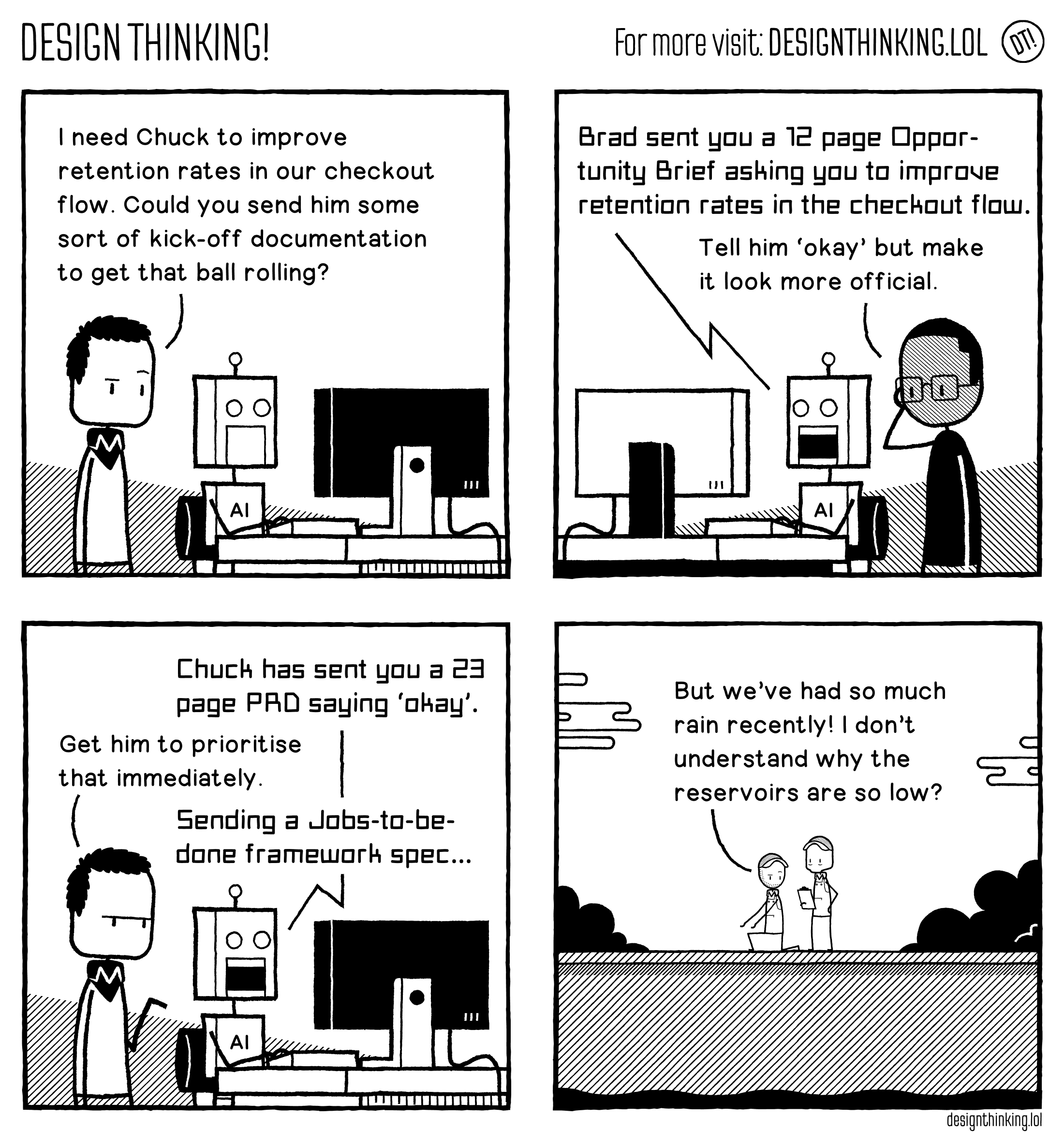
I’m quickly learning that this is probably the most pervasive sort of work-side AI slop we’re all seeing, even outside of the Tech Industry bubble. People creating vast crap documents that we’re all forced to read or get AI to read for us and then respond with even MORE AI doc slop. It’s all awful, all the way down.

Fridays are when I get a bit more personal: chatting about what I'm working on, sharing sketches of WIP strips, dredging up old stuff from my cartooning past and recommending some music i’ve been listening to lately. You can also claim your own DT! avatar. Come and join us beyond the paywall…

Subscribe now


Got a bunch of sketches done recently for new strips. This one I tried to note down as fast as I could, but I can already feel it starting to subtly change in my head the more I think about it…

Read more


Read the whole story
tante
7 days ago
reply
"I just use AI to help with my emails"
Berlin/Germany
Share this story
Delete
Next Page of Stories